Your books, filled in by the till.
Every sale, every payment and every wage the shop writes down arrives here on its own. Nothing is typed twice, and nothing is waiting to be typed at the end of the month.
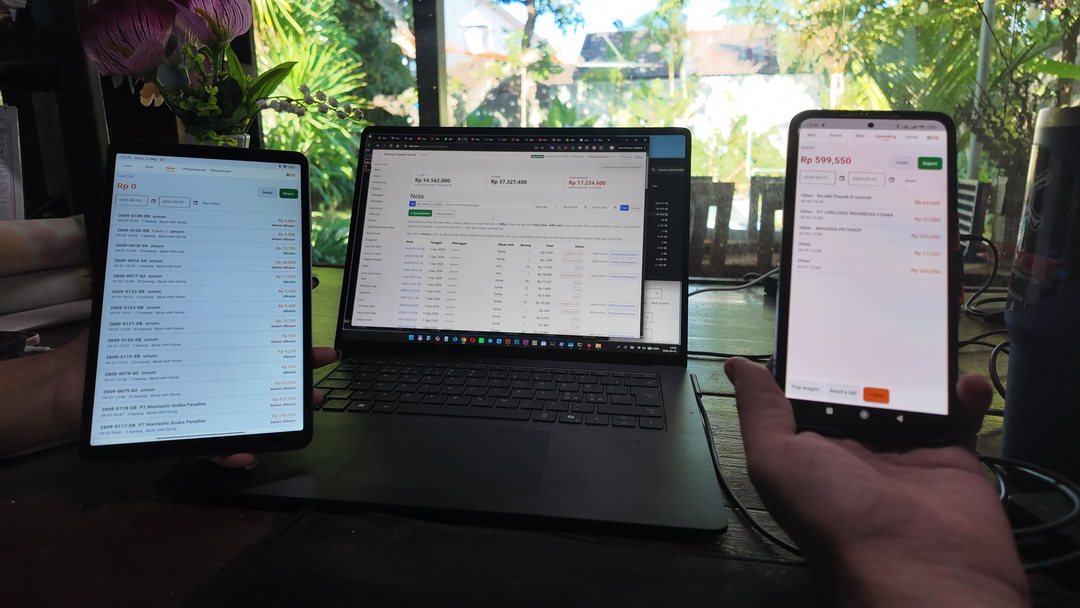
Every sale, every payment and every wage the shop writes down arrives here on its own. Nothing is typed twice, and nothing is waiting to be typed at the end of the month.
Every shop here shows what is really on its shelves, straight from its own till. Somebody looking for a thing finds the shops near them that have it, at what each one charges - and walks in.
No commission, no listing fee, no payment cut, no paying to be shown higher up. The customer pays you, in your shop, the way they always have. What you charge for BOS Online is what BOS Online costs, and it does not go up because you had a good month.
A marketplace puts you on a page beside forty sellers of the same thing, sorted by who is cheapest. Here a customer sees which shops nearby have what they want - and the one who has it in stock today, five minutes away, usually wins. That is a fight you can actually win.
One shop on a search page is a shop. Forty shops is a reason for somebody to look here first instead of opening an app that charges you to be in it. Every shop that joins brings the customers who were looking for something else.
You are not running a second shop online. Sell the last one at the counter and it stops being listed, because the till said so. Change a price once and it is changed everywhere.
You choose whether your shop is listed at all, and you can turn it off in one press. It starts off.
See how a customer searches Compared with Tokopedia and ShopeeAccounting software is usually a place to TYPE what already happened. Somebody sits down at the end of the month with a pile of receipts, and what comes out is as good as their memory and their patience.
This has no pile. The till wrote it down at the counter, in front of the customer, and the books filled in behind it - every sale as a journal entry, keyed to the sale it came from. A shop that never opens the accounting side still has accounts, and they are right up to this morning rather than up to last month.
Double entry, with a chart of accounts in your own language. Every sale, payment and spend becomes an entry keyed to where it came from - so nothing is ever counted twice, and a crooked entry is refused as it is written rather than found weeks later by somebody trying to file. Press any figure and the entries behind it are underneath.
All three from the same journal, so they cannot disagree with each other. Profit counts a sale on the day it happens; cash flow counts the money on the day it arrives - and a good month where everybody paid late is a month with nothing in the drawer.
Both aged the way an accountant asks for: under 30, 30 to 60, 60 to 90, over 90. A customer's debt is aged from the sale because nobody agreed a date; a supplier's from the day it was due, because somebody did. "They owe 4,200,000" and "they have owed it since November" are different sentences.
Paste the rows out of whatever your bank showed you - any bank, any order of columns. It finds what matches and says what does not, which is usually a fee nobody wrote down or money that has not landed yet.
A sale remembers what it cost on the day it was sold, so a gross profit from March is not worked out from August's prices. Things the shop owns wear out month by month - evenly, or faster at first - and that cost never appears on a bank statement, which is exactly why it is missing from books kept by hand.
PPN here, VAT in Europe, GST in Singapore - you type the name, the rate and what it is charged on, because those move and a number written into a program cannot be corrected when they do. The same for what comes off a wage: BPJS and PPh 21, EPF and SOCSO, CPF. Payslips print, and show what the shop paid on top.
One press: sales, payments, spending, stock, customers, the journal, the chart of accounts, tax and wages. Your accountant does not want our screens - they want the rows in the tool they already use, and a system that will not hand its data over is a system an accountant tells you to leave.
Phones, a laptop, a till on the counter and one in the office - all the same shop. More than one warehouse if you keep stock in more than one place, and stock counted as movements rather than a number, so two devices selling at once cannot lose a sale.
Whatever your till sells from is what customers see: what you have, at what you charge, with your name and your WhatsApp on it. Nothing to upload and nothing to keep up to date. It is off until you turn it on.
It does not file your tax. Every filing format is set by somebody who changes it, and a file guessed at by a program is a filing that comes back - so this works out the numbers and hands your accountant every line behind them, and they file it the way they always do.
It will not do everything a system built for a factory does: no manufacturing, no projects, no consolidating four companies into one set of accounts. It is the books of a SHOP, done properly, by the device that is already ringing up the sales.
And it is new. The books balance because a crooked entry is refused as it is written - but if something here does not match what your accountant expects, we would rather hear it than have you work around it.
3 people
USD 220 a year
6 people
USD 400 a year
10 people
USD 650 a year
Put the app on one phone, sell for a week, and see what arrives here. Nothing has to be decided before that.